
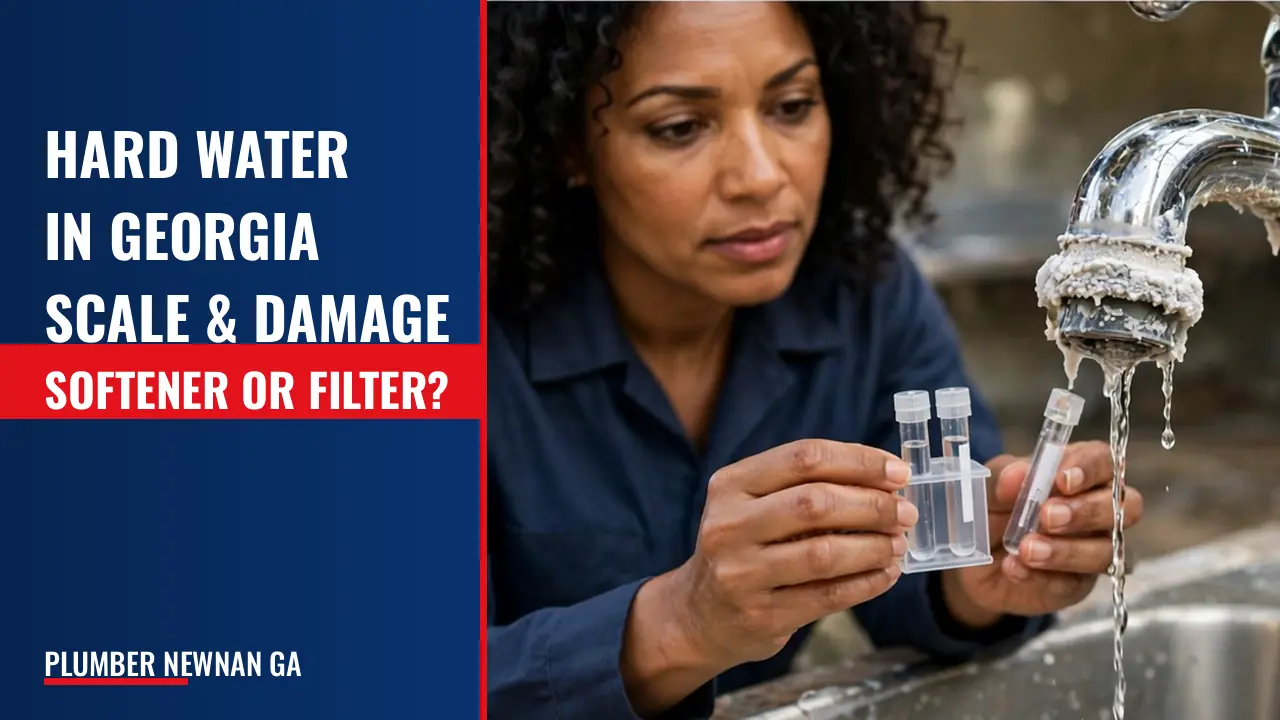
What hardness, softeners, filtration and scale have to do with each other
Hard water carries dissolved calcium and magnesium that turn into scale on hot surfaces, and a water softener removes those minerals while a filter removes other contaminants the softener cannot. Together they decide how long your water heater, fixtures and pipes last, and which failures you will see first.
This page explains how regional hardness creates scale, what softeners and filters each do, and how to tell whether a symptom is a water-quality problem or a plumbing repair.
What is water hardness and why does it cause scale?
Water hardness is the amount of dissolved calcium and magnesium in your water, measured in grains per gallon, and scale forms when heat or pressure causes those minerals to drop out of the water and stick to metal. The higher the hardness, the faster scale builds, and the more it costs you in lost efficiency and shortened equipment life, as we cover in our blog.
Hardness varies by source. Water from a municipal system is treated but still carries minerals, while private wells often run harder and can also carry iron, sulfur or sediment that a softener alone will not fix. Because the mix changes from one water source to another, the same softener setting that works well in one home may be wrong in the next.
How does a water softener actually remove hardness?
A water softener runs hard water through a tank of resin beads that swap calcium and magnesium for sodium or potassium, then periodically flushes the captured minerals to drain in a regeneration cycle. The softener does not filter water in the usual sense; it exchanges one mineral for another so the water no longer deposits scale.
The resin has a capacity, and regeneration uses salt to recharge it. When the salt runs out, the bypass valve sticks, or the resin is fouled, the softener keeps running but stops softening, and scale returns without any obvious warning. That is why softener maintenance is mostly about checking salt, watching for salt bridges, and confirming the unit is actually regenerating, and why it is worth getting in touch with us when it needs a professional.
How is water filtration different from softening?
A water filter removes particles and contaminants such as sediment, chlorine, lead or organic compounds, while a softener targets hardness minerals only. Most homes need both if the goal is water that is both soft and clean, because a softener will not remove sediment or taste and a carbon filter will not stop scale.
Filtration comes in point-of-use and whole-house forms. A whole-house filter protects every fixture and appliance, while an under-sink filter protects only the tap it serves. The right choice depends on what is in the water, which is why a water test comes before any treatment decision.
What symptoms point to a water-quality problem rather than a plumbing failure?
White crust on faucets, cloudy glassware, stiff laundry and reduced hot-water flow are the usual signs that hardness is depositing scale inside your plumbing and water heater. These symptoms tend to appear gradually and across several fixtures at once, which separates them from a single leaking valve or a clogged drain.
Scale inside a tank water heater or tankless water heater shows up as popping sounds, longer heat times and eventually a failed element or heat exchanger. A softener that has stopped working often produces the same pattern, so the first job is to confirm whether the softener is softening before assuming the heater is failing.
What can a homeowner safely check and do?
A homeowner can safely check salt level, look for salt bridges, test hardness with a simple kit and confirm the softener is set to the right grain level for the water. These checks catch most softener problems before they turn into scale damage.
1. Look at the salt tank and confirm salt is above the water line and not bridged into a hollow crust. 2. Run a hardness test on untreated and treated water to see whether the softener is actually working. 3. Check the bypass valve to make sure it is not stuck open. 4. Confirm the regeneration schedule matches your household's water use. 5. Record what you find so a plumber can pick up where you left off.
Do not open the resin tank, attempt to replace the control valve, or bypass a softener permanently without understanding what that does to your plumbing. Those steps risk damage and can void a manufacturer's warranty.
Water quality becomes a plumbing job when the softener or filter needs repair, replacement or a change in setup, or when scale has already damaged a water heater, fixture or pipe. A licensed master plumber can test the water, inspect the treatment equipment and trace scale damage to its source instead of guessing.
Repair versus replacement depends on the age of the unit, the condition of the resin or filter media, and whether the problem is a single part or the whole system. A softener that needs a valve or resin change is usually worth repairing, while one that has been bypassed for years and has scale throughout the plumbing may be better replaced. The same logic applies to a scaled water heater: sometimes a flush restores it, sometimes the tank or heat exchanger is already compromised.
What mistakes make hardness and scale problems worse?
The most common mistake is turning up the water heater temperature to compensate for slow hot water, which speeds up scale formation and shortens the heater's life. The second is ignoring a softener that has stopped regenerating, so hardness keeps building inside the plumbing while the homeowner assumes the water is treated.
Another mistake is adding a filter without testing the water first, which can leave the actual hardness problem untouched. A water test tells you whether you need softening, filtration or both, and it prevents paying for equipment that does not address the symptom you are seeing.
Water quality questions homeowners ask
Here are the questions that come up most often when hardness and scale are part of the conversation.
Do I need a water softener if I already have a filter?
Yes, in most cases. A filter removes sediment, chlorine or other contaminants but does not remove the calcium and magnesium that cause scale, so a softener is still needed if hardness is the problem. A water test confirms which treatment you actually need.
How do I know if my softener is working?
Test the water at a tap before and after the softener. If hardness is unchanged, the softener is not softening, which usually means salt is low, the resin is fouled or the bypass valve is stuck. A plumber can confirm which part is at fault.
Can scale damage a tankless water heater?
Yes. Scale coats the heat exchanger and reduces flow and heat transfer, which can lead to error codes and premature failure. Regular descaling and correct water treatment extend the life of a tankless unit.
Should I repair or replace a failing water softener?
It depends on the unit's age, the condition of the resin and whether the fault is a single part. A valve or resin replacement is often worthwhile, while a unit that has been bypassed for years and allowed scale throughout the plumbing may be better replaced.