
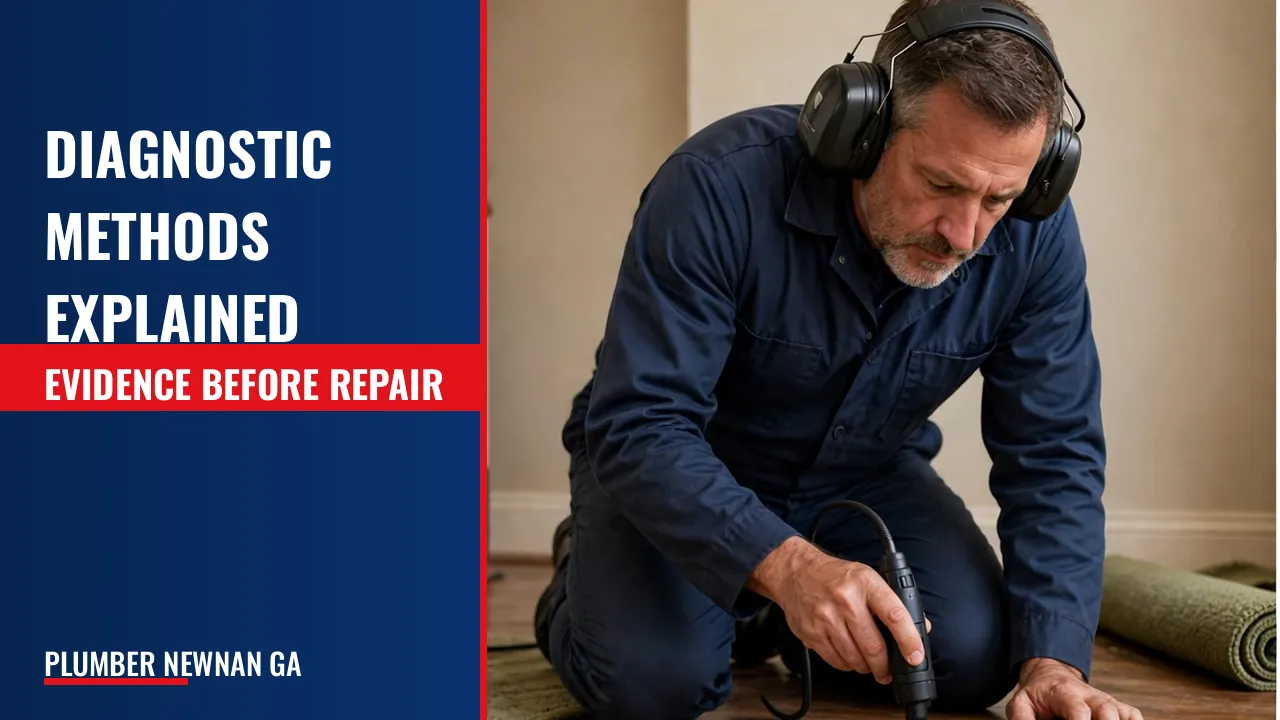
What the diagnostic methods actually decide
Diagnostic methods are decision steps, not a menu of services. Leak detection decides whether water is escaping and roughly where; video pipe inspection decides whether a pipe is broken, blocked or root-invaded; hydro-jetting decides whether a line can be cleaned rather than replaced; camera evidence decides what repair is justified and what the customer receives as proof.
The method you need depends on the symptom, not on preference. A wet spot on a slab points to leak detection first.
Why are these methods called decision steps rather than services?
A decision step is a test that changes what happens next. Leak detection, video pipe inspection and hydro-jetting each produce a finding that rules work in or out, so the plumber is not guessing and the homeowner is not paying for a repair that may not fix the problem. You can read more about these steps on our blog.
Without a decision step, a plumber can only react to what is visible. A water stain on a ceiling might come from a supply line, a drain, a roof leak or a water heater connection. Leak detection narrows that list before any wall is opened. A backup might come from a soft clog, roots or a collapsed pipe; a camera tells you which, and jetting is only safe once you know the pipe can take the pressure.
How does leak detection work as a decision step?
Leak detection uses non-invasive tools to find where water is escaping without opening walls or breaking slab. The plumber listens for the sound of moving water, checks pressure at fixtures, and may use thermal imaging or moisture meters to map where the wet area actually is.
The decision it makes is whether the leak is on a supply line, a drain line, or a fixture connection, and whether it is under a slab or in a wall. That finding decides whether the next step is a copper pipe leak repair, a slab repair, or a fixture replacement. A water leak that shows on a meter with every fixture off is a supply-side leak; one that only appears after a drain runs is a drain leak. Leak detection is the step that separates those two before any cutting starts, and it is one of the plumbing repair services we provide.
How does video pipe inspection work as a decision step?
Video pipe inspection feeds a camera through a drain or sewer line and records what the pipe looks like from the inside. The camera shows cracks, offsets, root intrusion, grease build-up and collapsed sections that no amount of snaking can reveal from above.
The decision it makes is whether the line can be cleaned or must be repaired or replaced. A pipe with roots at a joint may be jetted and then monitored; a pipe with a collapsed section cannot be jetted safely, because the jetter can damage the pipe further or get stuck. Camera evidence is also what the customer receives: a recording of the pipe at the point of failure, so the repair is based on what is there, not on a description. A sewer line requires video pipe inspection before any trenchless or open repair is chosen.
How does hydro-jetting work as a decision step?
Hydro-jetting uses high-pressure water to clear grease, scale, sludge and roots from a drain or sewer line. It is not a camera and it is not a snake; it cleans the pipe so the next inspection can see the actual condition of the walls.
The decision it makes is whether the blockage is soft material that can be washed away or a structural problem that jetting will not fix. In most homes, a line that backs up repeatedly is jetted first, then inspected with a camera to confirm the pipe is clear and intact. Jetting a pipe that is already cracked or collapsed can make the failure worse, which is why the order matters: camera first when the pipe condition is unknown, jetting first when the blockage is clearly grease or soft debris.
What changes which diagnostic method comes first?
The symptom and the pipe material decide the order, not a standard script. A wet floor with no visible source starts with leak detection. A sewer backup with a known history of roots starts with a camera. A kitchen drain that drains slowly but never backs up often starts with jetting.
Pipe material changes the risk. Older cast iron and clay lines crack and offset, so a camera is used before jetting to avoid breaking a fragile pipe. Plastic and copper lines tolerate jetting better, but a camera still confirms whether the blockage is grease or a foreign object. Access also matters: a line with no cleanout may need one installed before a camera or jetter can enter, and that changes the sequence.
What can a homeowner safely check before calling a plumber?
A homeowner can safely check the water meter, look for visible moisture and listen for running water with every fixture off. These checks do not replace leak detection, but they tell you whether the problem is active and whether it is supply-side or drain-side.
Steps that are safe to do:
1. Turn every tap, appliance and outdoor spigot off, then watch the water meter for movement. Movement means water is escaping somewhere on the supply side.
It becomes a professional job when the symptom is active, recurring or hidden, because the diagnostic tools and the judgement to read them are licensed work. A master plumber on staff can interpret a camera recording, a pressure reading or a thermal image and decide whether repair or replacement is the right call. If you are unsure, contact us to have a professional assess it.
Leak detection under a slab, sewer camera inspection, hydro-jetting a main line and any gas-related diagnosis are not homeowner tasks. They need the right equipment and the insurance that comes with licensed work. A plumber who performs leak detection and video pipe inspection can also give you the evidence in hand, which matters if you later sell the home or file an insurance claim.
What evidence should you receive after a diagnostic visit?
You should receive the finding in a form you can keep: a camera recording or still images of the pipe, a description of where the leak or blockage is, and a clear statement of what was ruled out. Evidence is the difference between a diagnosis and an opinion.
Ask what the test showed and what it did not show. A camera inspection that stops at a collapse has still produced evidence: it shows where the pipe fails. A leak detection that finds moisture but not the source has narrowed the area, and the next step is a more targeted test. The diagnostic explainer on how these methods produce evidence walks through what the customer receives after each method.
Diagnostic methods: questions answered
These are the questions homeowners ask most about how leak detection, camera inspection and jetting actually decide the repair.
What is diagnostic methods (leak detection, video pipe inspection, hydro-jetting, camera evidence) are named but never explained as a decision step?
Diagnostic methods are the tests a plumber uses to decide what is wrong and what repair is justified. Leak detection finds where water is escaping, video pipe inspection shows the inside of a pipe, hydro-jetting clears a line so it can be inspected, and camera evidence is the recording that proves the finding.
How does diagnostic methods (leak detection, video pipe inspection, hydro-jetting, camera evidence) are named but never explained as a decision step work?
Each method answers a different question. Leak detection answers whether water is escaping and roughly where. Video pipe inspection answers whether a pipe is cracked, blocked or root-invaded. Hydro-jetting answers whether a line can be cleaned rather than replaced. Camera evidence answers what repair to do and gives the homeowner a record.
What should I know about diagnostic methods (leak detection, video pipe inspection, hydro-jetting, camera evidence) are named but never explained as a decision step?
The order matters. A camera is used before jetting when the pipe condition is unknown, because jetting a cracked pipe can make it worse. Leak detection comes before opening a wall or slab. Ask for the camera recording or the leak-detection finding so the repair is based on evidence you can see.
Can I skip the diagnostic step and just have the repair done?
No, skipping it usually costs more. A repair without a diagnostic step is a guess, and a guess can replace the wrong section of pipe or jet a line that needed replacement. The diagnostic step is what makes the repair a decision rather than a trial.