
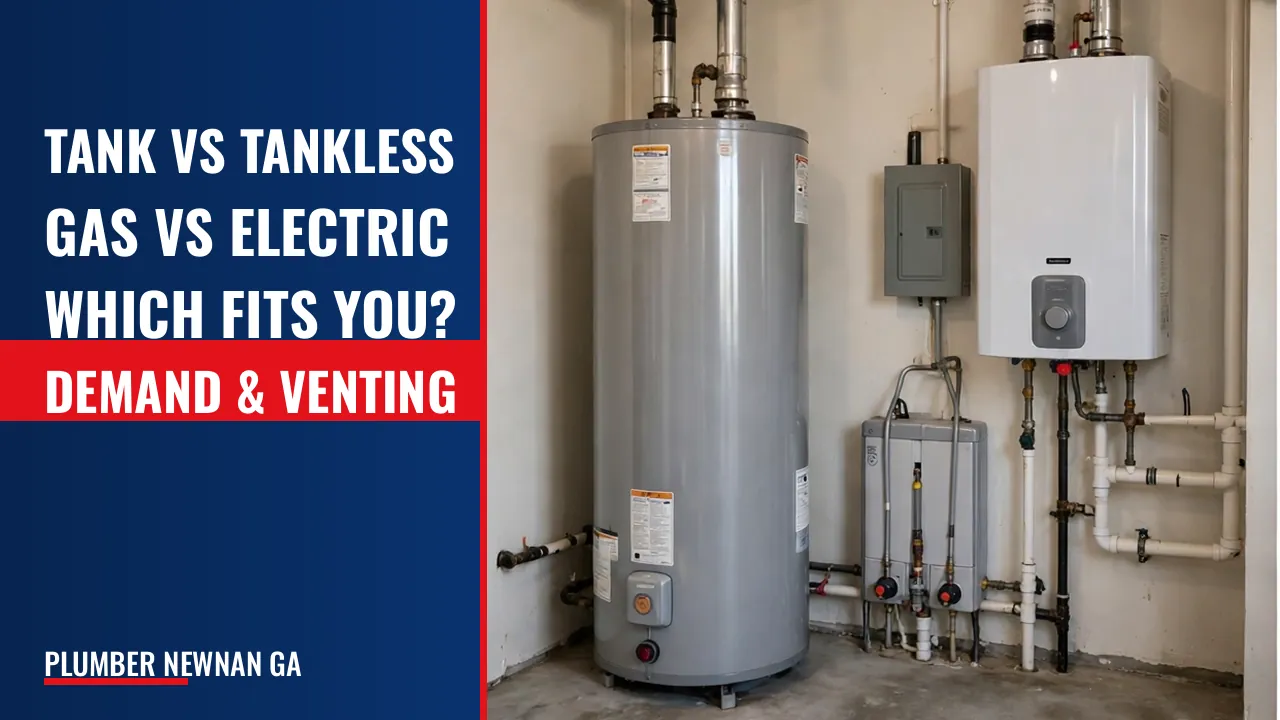
Which water heater fits your home: tank or tankless, gas or electric?
The right choice depends on three things: how much hot water your household uses at once, what venting your home can support, and what the installed cost looks like over the life of the unit. A tank water heater stores hot water ready to use, while a tankless unit heats water on demand; gas units usually recover faster, and electric units are simpler to install where gas is not available. For more on these trade-offs, see our blog.
How does a tank water heater work, and when is it the better choice?
A tank water heater stores a fixed volume of hot water in an insulated tank and reheats it as it cools, so hot water is ready the moment you open a tap. That stored supply is why a tank can serve several fixtures at once, up to its capacity, and why it runs out after heavy use until the burner or element catches up.
Tank units are the usual choice in most homes because they cost less to install, work with existing venting in many cases, and do not require the gas line or electrical upgrades a tankless unit sometimes needs. The trade-off is standby heat loss and a planned replacement cycle: the tank itself has a finite life, and an aging unit carries a higher risk of leaking. If your demand is moderate and predictable, a tank is often the practical answer.
How does a tankless water heater work, and when does it make sense?
A tankless water heater heats water only when a hot tap opens, so it avoids the standby energy loss of a storage tank and can supply continuous hot water within its flow capacity. That efficiency and space saving are real advantages, but they depend on the unit being sized to the home’s peak demand and on the venting and fuel supply being right.
Tankless makes sense when several people use hot water at once, when floor space is tight, or when the existing tank is failing and the homeowner wants a longer service life. It is a poor fit when the electrical service cannot support an electric unit, when venting runs are difficult, or when the household’s peak flow exceeds what a single unit can handle. A tankless water heater repair call often traces problems to sizing or venting rather than the unit itself.
Gas or electric: which fuel type changes the answer?
Gas water heaters usually recover faster and cost less to run per unit of heat in many areas, while electric units are simpler to install where a gas line is not present. The fuel choice changes both the installed cost and the venting requirements, so it is rarely a free choice.
A gas tankless unit needs a dedicated gas line sized for its input and a venting route that meets code, which can add to the installation. An electric tankless unit may need a larger electrical service and dedicated circuits; an electric tankless water heater installation often hinges on the panel’s capacity. In most homes the existing fuel and venting decide the path before efficiency does.
What does household demand actually mean for sizing?
Household demand is the peak number of hot-water fixtures running at the same time, measured in flow rate, not the number of bathrooms. A tank is sized by storage volume and recovery rate; a tankless unit is sized by flow capacity and temperature rise.
Two showers running together, a dishwasher, and a laundry cycle set the peak. If that peak exceeds a tankless unit’s capacity, hot water temperature will fluctuate or drop, which is why sizing comes before brand or price. A tank that is too small runs out; a tankless unit that is too small cannot keep up. Both are demand problems, not repair problems.
What venting and installation constraints change the choice?
Venting is often the deciding constraint: a gas tank needs a flue, and a gas tankless unit needs a specific venting configuration that may not match the existing route. Electric units avoid venting entirely, which is why they are common where gas venting is difficult.
Installation also depends on the gas line size, electrical panel capacity, water line condition, and whether the new unit fits the space. A tankless unit mounted on an exterior wall may need freeze protection in cold snaps. These are the conditions that make two homes with the same demand end up with different answers.
How is installed cost built up, and what is a fair price?
Installed cost is the unit plus the labour and materials to make it work in your home: removal of the old unit, venting or electrical work, gas line changes, water line connections, and code-required fittings. A fair price reflects those site conditions, not just the box on the shelf.
A like-for-like tank swap is usually the least involved. A tankless conversion often adds venting, gas or electrical work, and sometimes a larger gas line. That is why two quotes for the same model can differ: one includes the venting and electrical upgrades, the other does not. Ask what is included in writing, and compare the scope, not the total alone. For the repair-versus-replace decision behind the cost, see when is repair the right choice versus replacement.
What can you do yourself, and what should you not?
You can check demand, read the rating plate, note the fuel type and venting route, and keep the unit maintained. You should not install, convert, or repair gas or electrical water heating equipment yourself, because those jobs involve gas piping, combustion venting, and electrical circuits that require a licensed professional.
Safe homeowner steps: 1) List how many hot fixtures run at once at peak. 2) Photograph the rating plate and the venting or electrical connections. 3) Check for leaks, corrosion, or inconsistent hot water. 4) Flush a tank annually if the manual calls for it. Do not open the gas valve, alter venting, or rewire a circuit. For repair work on an existing unit, a water heater repair call is the safe route.
It becomes a professional job the moment the work involves gas piping, electrical circuits, venting, or the removal and replacement of the unit.
A professional also measures demand and venting on site, which is what makes the tank-versus-tankless and gas-versus-electric answer specific to your home rather than generic. If the unit is leaking, running out of hot water, or showing inconsistent temperature, that is a repair or replacement decision best made with someone who can inspect the whole system. The same reasoning applies across plumbing repair work generally.
Tank versus tankless water heater, and gas versus electric: questions answered
Here are the questions homeowners ask most when comparing options.
What is included in the price of a tank versus tankless water heater, and gas versus electric, given household demand, venting, and installed cost?
The price usually includes the unit, removal of the old heater, labour, and the materials to connect it: water lines, gas line or electrical work, venting, and code-required fittings. Tankless conversions often add venting or electrical upgrades that a like-for-like tank swap does not need.
What is a fair price for a tank versus tankless water heater, and gas versus electric, given household demand, venting, and installed cost?
A fair price reflects your home’s actual conditions, not a national average. The same model can cost more where venting must be rerouted or the electrical panel needs work. Compare written scopes, not totals alone, and ask what is excluded.
How can I keep the cost of a tank versus tankless water heater, and gas versus electric, given household demand, venting, and installed cost down?
Keep the existing fuel type and venting route where they are sound, size the unit to your real peak demand rather than the largest model, and maintain the unit so it reaches its expected life. Converting fuel type or venting is what usually adds cost.
Is tankless worth the money over a tank?
It depends on demand and site conditions. Tankless avoids standby energy loss and saves space, but the installed cost is higher and the savings depend on how much hot water you use. In homes with high simultaneous demand and suitable venting, the advantages are clearer.