
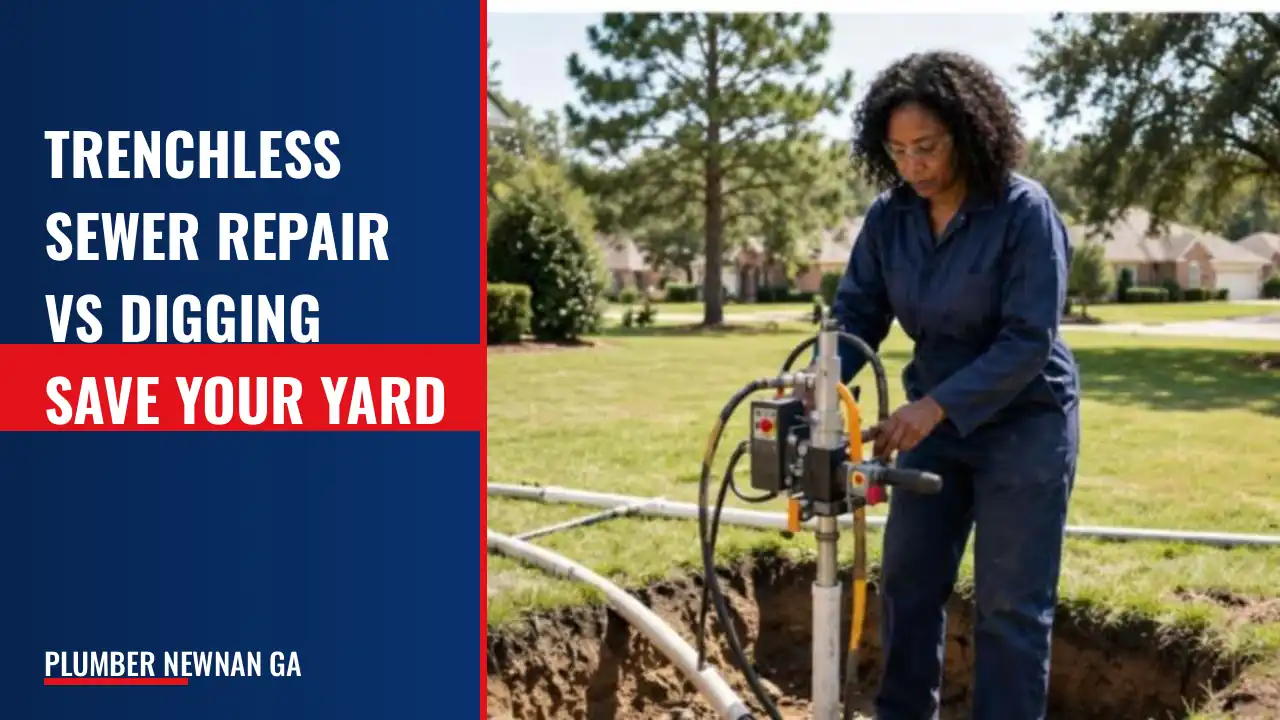
What Trenchless Sewer and Pipe Repair Means
Trenchless sewer and pipe repair fixes a buried pipe by working through small access points instead of digging a continuous trench along its length. It is appropriate when the pipe's problem is localized or the line can be rehabilitated from the inside, and excavation is the better choice when the pipe is collapsed, badly misaligned, or the soil and depth make trenchless methods impractical. For more on related topics, see our blog.
The rest of this guide explains how each method works, what conditions change the answer, and where a homeowner's own inspection ends and a licensed plumber's work begins.
How Does Trenchless Sewer and Pipe Repair Work?
Trenchless repair works by reaching the pipe through two small pits, or through existing cleanouts, and then either coating the inside of the pipe or pulling a new liner or pipe through it. The three common methods are cured-in-place lining, pipe bursting, and slip lining, and each one leaves the surrounding yard, driveway, or slab largely intact.
Cured-in-place lining pushes a resin-saturated tube into the old pipe, inflates it against the walls, and cures it into a hard new inner surface. Pipe bursting pulls a bursting head through the old line that cracks it outward while dragging a new pipe behind it, so the outside diameter can stay the same or grow slightly. Slip lining pulls a smaller new pipe through the old one, which works when the old pipe is sound enough to act as a host and the drop in diameter does not matter.
All three methods depend on a camera inspection first. A plumber runs a camera through the line to find the break, the root intrusion, the bellied section, or the offset joint, and to confirm the pipe is still round enough and clear enough for the chosen method. Without that footage, trenchless work is a guess.
When Is Trenchless Repair Appropriate Versus Excavation?
Trenchless repair is appropriate when the pipe's defect is isolated, the line is still structurally sound enough to line or burst, and the surface above it is expensive or disruptive to dig up. Excavation is appropriate when the pipe has collapsed, when several sections are broken, when the grade is wrong, or when the line is too deep or too damaged for a liner to bond.
The decision usually comes down to four conditions: the pipe material, the type and length of the damage, the depth and soil, and what sits above the pipe. A clay or cast iron line with one cracked joint under a mature tree is a common trenchless candidate. A collapsed section under a driveway may still be trenchless if the surrounding pipe is sound, but a line that has failed in several places is usually an excavation or replacement job.
Trenchless is not always cheaper. It saves surface restoration, but the equipment and liner materials can cost more than a short open trench in an open yard. The right comparison is total cost, including putting the yard, walk, or slab back the way it was.
What Should I Know About Repair Versus Replacement for Pipes, Drains, and Sewer Lines?
Repair is the right choice when the pipe's problem is one localized defect and the rest of the line still has service life left. Replacement is the right choice when the pipe has reached the end of its material lifespan, has failed in more than one place, or when a repair would only postpone the same failure a few feet down the line.
For a sewer lateral, the lifespan question matters most. Clay tile and cast iron lines in older homes often last decades but crack, offset, or root-infiltrate as the soil moves. A camera inspection shows whether the line is failing at one joint or throughout, and that footage is the evidence a plumber should show you before recommending either path.
For interior drains, a single clogged or broken section under a sink or floor is usually a repair. For water pipes, repeated pinhole leaks in copper often point toward repiping rather than patching each leak as it appears. The same logic applies to fixtures: a faucet or toilet with a worn cartridge or valve is a repair, while a fixture that has cracked or corroded through is a replacement. For a closer look, see our guide to repair-versus-replace trade-offs.
What Can I Do Myself, and What Should I Leave Alone?
A homeowner can safely check for symptoms and gather information, but the repair itself belongs to a licensed plumber once the problem is underground or inside a wall. The safe steps are about observation, not opening pipe.
1. Note where the water backs up or the drain slows, and whether more than one fixture is affected. Multiple slow drains point to the main line, not a single trap.
2. Look for gurgling, sewage odor, or wet spots in the yard along the sewer route, and write down when they appear.
It becomes a professional job as soon as the problem is below ground, inside a slab or wall, or involves gas or electrical connections. Sewer and underground pipe work requires a licensed master plumber because the repair has to meet code, restore grade and flow, and be documented, and because a wrong repair can fail silently under the yard.
The professional step starts with diagnosis: a camera inspection of the sewer line and leak detection on water lines, so the recommendation rests on what the pipe actually looks like. From there, a plumber can tell you whether the line suits trenchless sewer line repair, trenchless pipe repair, or open excavation, and can show the footage behind that call. The same diagnostic standard applies to plumbing repair inside the home.
For a water heater, the professional line is crossed when the tank leaks, the pilot or burner will not stay lit, or the unit needs replacement. A plumber handles water heater installation and can confirm whether a tank or tankless unit fits the home's venting and gas supply before any work starts.
Trenchless Sewer and Pipe Repair: Common Questions
Here are the questions homeowners ask most often when a sewer or pipe problem turns out to be underground.
What is trenchless sewer and pipe repair, and when is it appropriate versus excavation?
Trenchless repair rehabilitates a buried pipe through small access points instead of a long open trench, and it is appropriate when the damage is localized and the pipe can still be lined or burst. Excavation is appropriate when the pipe has collapsed, failed in several places, or sits where trenchless methods cannot reach it.
How does trenchless sewer and pipe repair work?
It works by inserting a liner, a bursting head, or a new smaller pipe through the old line from two small pits or existing cleanouts. A camera inspection comes first to confirm the pipe's condition and to choose the method that fits it.
What should I know about trenchless sewer and pipe repair versus excavation?
Know that trenchless saves surface restoration but is not automatically cheaper, and that the right choice depends on the pipe material, the number and type of defects, and what sits above the line. Ask to see the camera footage before agreeing to either method.
Does trenchless repair work on every pipe?
No. Trenchless repair needs a pipe that is still round enough and sound enough to line or burst, so a collapsed or badly misaligned line usually calls for excavation instead.