
What maintenance agreements and scheduled maintenance programs cover
Maintenance agreements are paid or included plans where a plumber inspects, tests and tunes specific systems on a set schedule, and they typically cover water heaters, water softeners, drains and sewer lines, plus the fixtures and pipes around them. Coverage usually means a scheduled visit, a written condition report, and priority handling if something fails between visits.
What a plan actually covers varies by provider and by the equipment in the home.
What is a plumbing maintenance agreement and how does it work?
A plumbing maintenance agreement is a recurring arrangement in which a licensed plumber performs defined checks on your plumbing on a schedule, and you pay for that service either as a flat annual fee or per visit. The agreement sets out which systems are included, how often they are visited, and what happens if a covered part fails.
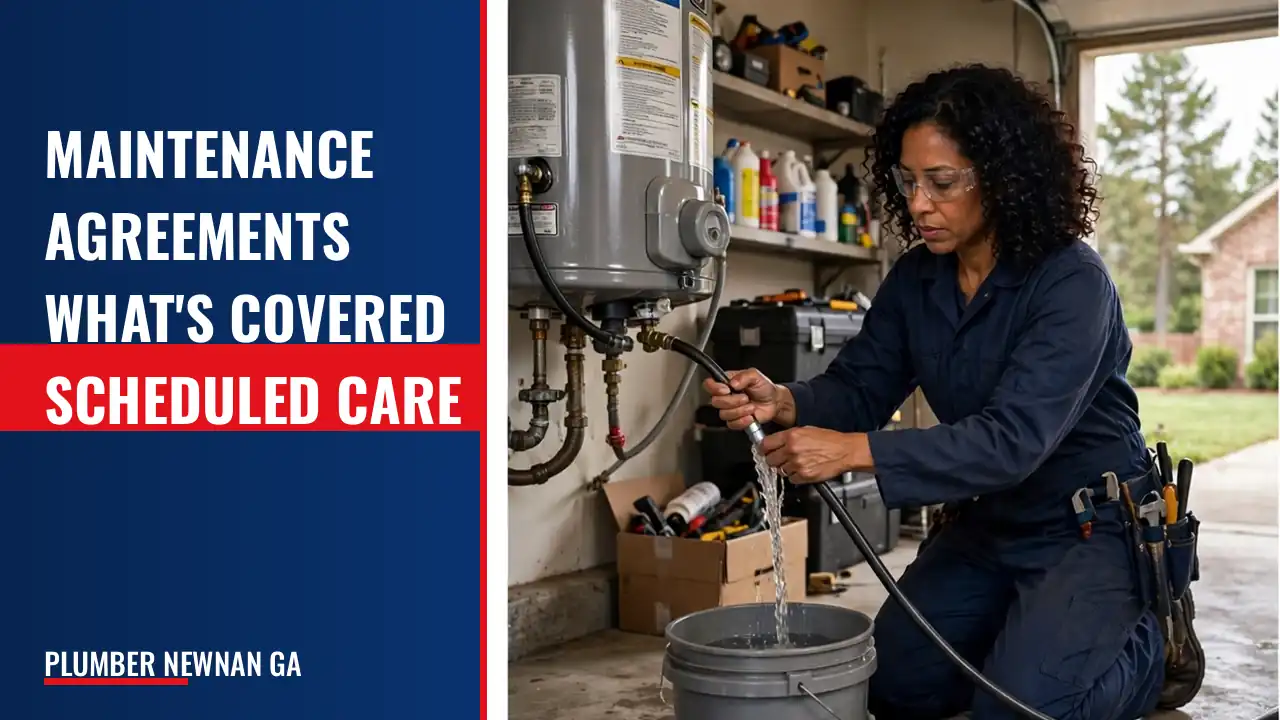
The work itself follows a checklist rather than a complaint. On a water heater, that means flushing sediment from the tank, testing the temperature and pressure relief valve, checking the anode rod and inspecting connections for corrosion. On a tankless unit, it means descaling the heat exchanger and checking the venting and gas connections. On drains and the sewer line, it means clearing slow spots before they block and, where included, running a camera to record the pipe's condition.
The value is in the record. Each visit should produce a written report of what was found, what was done and what is wearing out. That record is what lets you plan a water heater replacement before it leaks, instead of after.
What do these programs usually cover?
Most programs cover a defined list of systems and a defined list of tasks, and the two lists are what you compare when choosing between them. Coverage is usually grouped by equipment, not by the whole house.
Common inclusions are water heater maintenance, hot water tank maintenance, tankless descaling, water softener maintenance, drain cleaning on accessible fixtures, and a sewer line inspection. Some plans add fixture checks, shutoff valve exercise, leak detection walks and backflow preventer testing. Exclusions matter just as much: repairs, parts, excavation and emergency labor are often billed separately even when the visit is covered.
Ask for the checklist in writing before you agree to anything. A plan that names tasks is useful. A plan that promises 'peace of mind' is not.
What changes what a plan covers and what it costs?
The equipment you have, its age and its condition change both what a plan includes and whether it is worth having. A home with a tankless heater and a softener needs different tasks than one with a tank heater and no treatment.
Age is the biggest factor. A water heater near the end of its service life benefits from a plan mostly as a warning system, because the visits will document corrosion and sediment before failure. A newer unit benefits from the same visits as warranty protection, since manufacturers often expect maintenance records. Homes on a sewer line with mature trees should weight the sewer inspection heavily. Homes with hard water should weight softener and tankless descaling.
Two limits are worth knowing. First, a maintenance agreement is not a warranty; it is a service schedule, and repairs are usually separate. Second, coverage depends on access, so a sewer inspection may be limited if cleanouts are buried. Ask what happens when a covered task cannot be performed.
What can a homeowner do themselves, and what should they leave alone?
A homeowner can safely do the simple checks between professional visits, and should not open gas appliances, relief valves or sewer cleanouts. The line is drawn at anything involving fuel, pressure or waste.
Safe steps, in order:
1. Note the water heater's temperature setting and the date of the last flush.
Maintenance becomes a professional job when the task involves gas, the sewer line, electrical connections on a heater, or any repair beyond cleaning and inspection. A licensed master plumber carries the insurance and the training to work on those systems, and the work needs to be documented.
The signs that a scheduled visit should become a repair call include water pooling at the base of the heater, a relief valve that drips, a sewer backup that returns after clearing, and a tankless unit that shuts off with an error code. These are not maintenance items. They are failures in progress.
Documentation matters here too. Ask what the warranty covers and what the call-back policy is if the problem returns, because a maintenance plan is only as good as the paper behind it. The guide on what warranty covers parts and labor, and what is the call-back policy if the problem returns? explains how to read that. For the service behind the schedule, see water heater maintenance, hot water tank maintenance and the wider plumbing maintenance work. More background sits on the blog.
Maintenance agreements and scheduled programs: questions answered
Here are the questions homeowners ask most about plumbing maintenance plans.
What maintenance agreements or scheduled maintenance programs are available, and what do they cover?
Plans usually cover scheduled inspection and tuning of water heaters, water softeners, drains and the sewer line, plus a written condition report. Repairs and parts are typically billed separately, so ask for the checklist and the exclusions before you agree.
What is a plumbing maintenance agreement?
It is a recurring service arrangement with a defined checklist and schedule, not an insurance policy. You pay for visits, and the plan sets out what is inspected, how often, and what happens if a covered system fails between visits.
How does a scheduled maintenance program work?
A plumber visits on a set interval, performs the listed tasks, and leaves a record of the system's condition. That record is what lets you plan a replacement or a repair before a failure, rather than after.
What should I know before choosing a plan?
Compare the task list, the exclusions, the warranty terms and the call-back policy, not the headline price. A plan that documents condition and names its exclusions is more useful than one that only promises priority service.